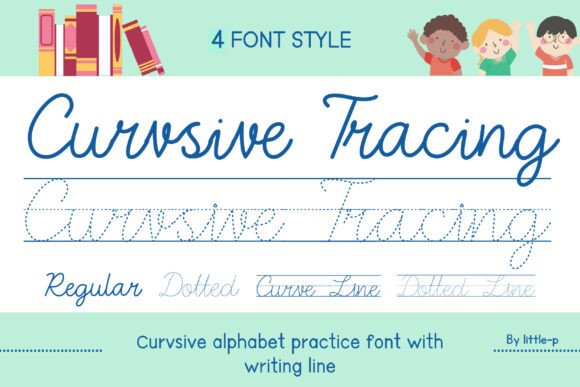
Curvsive Tracing: A Smart Approach to Teaching Handwriting
In a world saturated with digital inputs, the tactile skill of handwriting remains a cornerstone of early education and cognitive development. However, teaching cursive writing often presents a hurdle for educators and parents alike. The transition from block letters to flowing script can be frustrating for young learners without the right tools. This is where typography meets pedagogy. Curvsive Tracing is not merely a typeface; it is an educational system designed to bridge the gap between recognizing letters and independently writing them. By offering structured guidance directly within the letterforms, this font transforms standard worksheets into interactive learning experiences.
An Educational Typeface with Built-In Pedagogy
Unlike standard script fonts or generic handwritten fonts, Curvsive Tracing is engineered with specific instructional goals. The visual characteristics are clean and uncluttered, prioritizing clarity over artistic flourish. The letters maintain consistent proportions and baseline adherence, which is crucial for developing muscle memory. The personality of the font is supportive and approachable—it doesn't intimidate the student but rather invites them to follow along. The appeal lies in its versatility; it adapts to the learner's stage of development rather than forcing the learner to adapt to the font.
The core strength of this system lies in its four distinct styles, which allow for a scaffolded learning approach:
- Regular: This serves as the model. It displays the full, connected cursive letter, giving the student a visual goal of what the final product should look like.
- Dot: In this style, the letter is rendered as a series of dots. This guides the student’s hand along the correct path without the restriction of a solid line, encouraging fluid motion and rhythm.
- Curve Line: Here, the student sees the trajectory of the letter as a thin, continuous line. They trace over this guide to form the bold strokes of the letter, helping them understand the pressure and flow required for cursive.
- Dot Line: Combining the previous two concepts, this style offers a dotted guide line that the student traces over to create the solid letterform. It is the final bridge before independent writing.
Practical Applications for Educators and Creators
While the primary audience is teachers and homeschoolers, the utility of Curvsive Tracing extends to anyone creating educational content. For designers working in the education sector, this font is a vital design asset. It eliminates the need for complex vector tracing or manual dotted lines in software like Illustrator or Canva. You simply type the text and select the appropriate style.
This font is ideal for:
- Worksheets and Printables: Creating custom handwriting practice sheets that align with specific curricula or vocabulary lists.
- Handwriting Practice Books: Publishers can use the font to generate entire workbooks with progressive difficulty levels.
- Classroom Decor: Using the "Regular" style to create wall posters that serve as constant visual references for students.
- Digital Learning Platforms: Integrating the font into interactive PDF or web-based learning modules where students practice on tablets.
Design Strategy: Readability and Hierarchy
From a modern typography perspective, Curvsive Tracing solves a specific readability problem. In educational design, visual hierarchy is not just about aesthetics; it is about cognitive load. If a worksheet is cluttered or the letterforms are ambiguous, the student spends more time decipherating the shape than practicing the motor skill.
Curvsive Tracing influences brand perception for educational businesses by projecting an image of professionalism and care. When a tutoring center or educational app uses high-quality, purpose-built typography, it signals to parents that the content is expert-curated. It moves the materials away from the "generic clipart" look toward a cohesive brand identity that values quality instruction.
Furthermore, the font aids in maintaining consistency. Whether you are creating a math worksheet or a history essay template, the handwriting guide remains uniform. This consistency reduces confusion for the student, allowing them to focus on the content rather than the mechanics of the font itself. It is a premium font solution that serves a functional purpose, much like a well-designed sans serif serves a UI interface.
Integrating Curvsive Tracing into Your Workflow
For entrepreneurs, crafters, and content creators, adopting Curvsive Tracing is straightforward. However, a few practical considerations ensure the best results.
First, consider the medium. Since this is a tracing font, line weight matters. If you are printing worksheets, ensure your printer settings are calibrated for crisp edges. The "Dot" and "Dot Line" styles rely on clear separation between points; a low-resolution print can turn these dots into a muddy line, defeating the purpose.
Second, think about font pairing. While Curvsive Tracing handles the practice lines, you will need a complementary typeface for instructions and headings. A clean sans serif font works best here. Avoid pairing it with a serif font or an overly decorative display font, as these can create visual competition. The instructions should be easy to read so the focus remains on the tracing exercise.
Finally, understand the licensing. For small business owners looking to sell resources on platforms like Teachers Pay Teachers or Etsy, ensuring you have a commercial font license is essential. Curvsive Tracing is designed for this exact use case, allowing you to create and sell end-products (like printed workbooks or digital downloads) without legal ambiguity. This makes it a safe and scalable investment for your creative business.
In summary, Curvsive Tracing is more than just a creative font; it is a functional tool that supports the developmental milestone of learning to write. By utilizing its four instructional styles, educators and designers can create materials that guide students from passive observation to confident, independent cursive writing.